
|
Fishing for other Tiger Musky, Northern
Pike, Chain Pickerel, Sauger, Saugeye, Aligator Gar, Longnose Gar,
Spotted Gar, Bowfin, Paddlefish in Arkansas.
Arkansas offers unique fishing opportunities. Listed below find
information about species of fish found in Arkansas which may not
be featured in the main section of AA- Fishing.com.
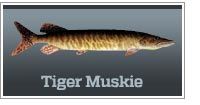
Tiger Musky - Muskellunge
Esox lucius ~ Esox masquinongy
USA Record: 51.2 lbs.
The tiger muskellunge is a cross of the musky and northern pike. Male
Tiger Muskellunge are most often sterile yet some females are fertile.
Tiger muskies tend to be smaller than non-hybrid muskies but grow very
fast. The body is often quite silvery with brownish fins and tail, without
spots but displays broken vertical markings. Like their parent, they
eat any fish they can catch and prefer to ambush their prey. They also
eat crayfish, frogs and birds. Use large lures and stout line when fishing
for tiger muskellunge. They will hit lures and fresh cut bait. They are
known for their speed and are exceptionally strong for short runs.
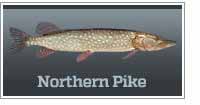
Northern Pike
Esox Lucius
IFGA Record: 55.1 lbs
The northern pike is a valient fighter and prefers water temperatures
from 58 to 70 degrees. Also known as jack, jackfish, great northern pike
and pickerel. While they have been transplanted into most states with
cold water, they are native to the northern states and are abundant in
the north-eastern states. Northern pike are basically olive in color
with white and/or yellow bellies. The northern pike has light-colored
marking on a dark body whish is opposite that of their cousins the muskies.They
are an ambushing predator that eats frogs, crayfish, birds and virtually
any fish they can get into their mouth. Use spinners, fish-immitating
lures, jerk-baits or cutbait and fish close to cover.
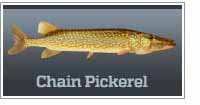
Chain Pickerel
Esox niger
World Record: 9.4 lbs.
A freshwater fish in the pike family easily identified by the "chain-like
marking along its sides. It can be found in the northwest, northeast
and southeast sections of the USA. Its primary food source is smaller
fish and is known to lie in wait to ambush its prey. While it can be
eaten it is not considered one of the better sport fishes for table fare.
The chain peickere can be caught on fish-imitation lures and live or
cut bait. Watch the sharp teeth when handling. Prefers water temperatures
from 62 to 70 degrees. Also known as pickerel, eastern pickerel, pike,
grass pike, jackfish, jack and others
Sauger
Stizostedion canadense
World Record: 17.7 lbs.
Excellent eating fish which typically runs a bit smaller than its cousin
the walleye. The sauger prefers cold and cloudy, moving water in the
60s to low 70s. They spawn in the low to mid 40s. You can tell them from
a walleye by the dark spotting on the dorsal fin, darker coloring and
the rough covering of the gill area. Due to their resembelance to pickerel,
they are also known as gray pickerel spotfin pike, gray pike, river pike
and others. When the water turns cold and other fish are hard to come
by, this is the time to fish for sauger.Fish with jigs, spoons and crankbaits
imitating crayfish or baitfish. Fish near the bottom and experiment with
presentation action and speed.
Saugeye
A cross between sauger and walleye.
USA Record: 15.6 lbs.
This is a fast growing fish but does not get as big as the walleye. It
successfully inhabits waters where the walleye has struggled. They prefers
water temperatures from 65 to 75 degrees. Look for them near bottom on
sandy bars and particularly along dropoffs and river channels. Use small
crankbaits that resemble minnows, shad or small crappies. Fish is their
primary food source.
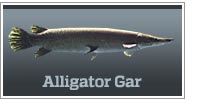
Aligator Gar
Lepisosteus spatula
World Record: 279 lbs
Found in lakes and waterways in the southeast United States. Of all the
gar species. the alligator gar is the largest. It is also the largest
exclusively freshwater fish found in the United States. Mature aligator
gar can top 300 pounds and exceed ten feet in length. This predator will
eat most anything that moves including fish, waterfowl, frogs, aligators
and other creatures found inhabiting its world. Most common methods for
catching include trot lines, live bait and bow fishing. Prefers warm
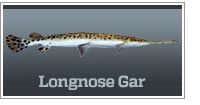
water temperatures. Also known as gar, garfish and gatergar. Longnose Gar
Lepisosteus osseus
World Record: 25 lbs
The Longnose Gar can be found in lakes and rivers and prefers quiet backwaters
with temperatures ranging from 80 to 90 degrees. Also referred to as
gar and garfish, It has a long, sword-like mouth loaded with sharp teeth.
They are nocturnal feeders and eat most smaller fish. They can be taken
on live bait, fish-imitating lures and nylon string "gobs designed
to entangle in their teeth. Most longnose gar are taken by bowfishing
or spear fishing. The meat is somewhat tasty but quite bony.
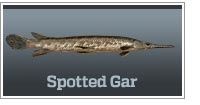
Spotted Gar
Lepisosteus oculatus
World Record:
Its range covers the northeast and into the southeast areas of the United
States. It prefers quiet, clear water and backwaters, slow-moving creeks,
rivers and sloughs. Named for the dark spots that cover its light-colored
body, the spotted gar is a predator feeding on various kinds of fishes,
frogs and crustaceans. Like most gar they are hard to catch on hook and
line. The best method is live minnows or other small fish. Most spotted
gar are taken by bow fishing or spear fishing.
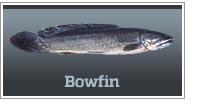
Bowfin
Amia calva
World Record: 21.5 lbs.
Found in waters around Alabama, Florida, Louisiana and Mississippi, the
bowfin prefers water temperatures of the warmer climates. It has an exceptionally
long dorsal fin which extends back to the tail, made of about 50 spines
or rays. Near the upper tail is an eye spot. They have very sharp teeth
and a nasty disposition when hooked. Handle with caution. They are most
often caught on cut bait and crayfish. They put up quite a fight and
are not considered good eating. The bowfin is also known as dogfish,
mud pike, mudfish, grindle, swamp bass and others.
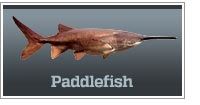
Paddlefish
Polyodon spathula
World Record: Over 600 lbs.
If you didn't know what they were, you might think you caught a shark
if you were to land a paddlefish. They have a powerful, sleek body and
a tall, rear dorsal fin.
Prefers water temperatures from 50 to 70 degrees. Also known as spoonbill,
spoonies, spadefish and shovelnose. They are filter-feeders which can be taken by snag or catch with rod and reel (or by net with appropriate lisence), in AR.
If you offer fishing guide services for any of these fish in Arkansas
we would like to include you as a resource for our visitors. We
offer a complimentary listing for your guide service on our Arkansas
Fishing Guides page or you can see other options to promote your
fishing guide services in Arkansas by visiting our Advertising opportunities
section.
AR Other Fishing - All About Fishing for Tiger Musky,
Northern Pike, Chain Pickerel, Sauger, Saugeye, Aligator Gar,
Longnose Gar, Spotted Gar, Bowfin, Paddlefish and
other fish in Arkansas.
|