
Salmon Fishing


By Timothy Kusherets,
Author - Steelhead & Salmon Drift-Fishing Secrets
Guide to fishing for Atlantic, coho, chum, chinook, kokanee, pink and sockeye salmon.
- Featured Salmon Fishing Video
- Instruction Video on Drift Fishing
- States With Prolific Salmon Populations
- Atlantic Salmon a.k.a. King or Grilse
- Chinook a.k.a. King or Tyee
- Chum Salmon a.k.a. Dog salmon & Blue-backs
- Coho Salmon a.k.a. Silver, Hooknose & Blue-back
- Kokanee Salmon
- Pink Salmon a.k.a. Humpback or Humpy
- Sockeye Salmon a.k.a. Red Salmon & Kokanee
- Alaska Salmon Fishing Video - Red Salmon
- Salmon Fishing on the Columbia River
This page is designed to convey general information of how to catch Salmon in both fresh and saltwater environments in the form of definitions. The layout is designed to cover identification; average weight; distribution; life span; angler value; techniques of fishing; and seasons to fish. Nuances associated with each particular species further differentiates them from each other and are peppered throughout each species description. The salmon profiles are listed in order of migration. Some of the runs overlap each other offering anglers a chance to fish for two species simultaneously.
Featured Salmon Fishing Videos
Fishing for salmon on the Klamath River
Salmon fishing on the Klamath River is a delight, with quality fish seemingly around every bend. Below this video, there's a complete listing of other salmon fishing videos you might enjoy. Visit often as we are continually adding new videos to help you catch more salmon.
All natural salmon fisheries can be found within the latitudes of 30 and 60 degrees in the northern and southern hemispheres. Recreationally and commercially they are an important food fish that are renowned the world over for both taste and fighting abilities.
Instruction Video on Drift Fishing.
This tutorial on drift fishing with Timothy Kusherets provides keys to catching big salmon, trout and steelhead on rivers and streams.
Most anglers prefer to fish for them on the lightest possible tackle to enhance each fight, but there are techniques to getting them out in the ocean waters that require heavier tackle. Once salmon are hooked, on down rigger setups, they race to the surface to put on aerial shows embedding memories that last a lifetime.
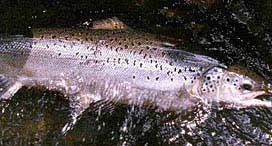
Each species of salmon has its own idiosyncrasies that distinguish them from other species. The habits of an ocean going salmon is not the same as salmon that migrate inland; with that in mind, the habits of both environments are addressed. In the estuary, below the mouth of a river, salmon begin the final phases if migration, and maturation, as it ceases to feed forcing fishermen to learn the innate behaviors of salmon and what will make them strike.
In the United States the distribution of all the species is enormous covering the greater portions of the northern states from the east coast to the west. While salmon can be found throughout Canada, these pages focus on the United States.
States that have prolific numbers are:
Alaska (Chinook, Pinks, Sockeye, Coho, and Chum)
California (Chinook, Coho, and Chum)
Connecticut (Atlantic)
Idaho (Chinook and Sockeye Kokanee)
Illinois (Atlantic, Chinook, and Coho)
Indiana (Atlantic and Kokanee)
Maine (Atlantic)
Massachusetts (Atlantic and Coho)
Michigan (Chinook, Coho, and Pink)
Minnesota (Chinook, Coho, Pink, and Sockeye, Kokanee)
New Hampshire (Atlantic and Sockeye, Kokanee)
New York (Atlantic, Chinook, Coho, and Pink)
North Dakota (Chinook)
Ohio (Coho, and Chinook)
Oregon (Chinook, Coho, Chum, and Pink)
Pennsylvania (Atlantic, Chinook, Coho, and Pink)
Washington (Chinook, Pink, Sockeye, Coho, and Chum)
Wisconsin (Atlantic, Chinook, and Coho)
Atlantic Salmon a.k.a. King or Grilse
salmo salar
This is the most prolific of all salmon. Ideal water temperature: 48° to 55°
World record: 79 pounds, 2 ounces
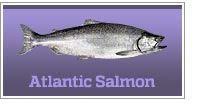
Identification: while ocean going, the Atlantic salmon is dark on the dorsal side and chrome from just above the lateral line to the underbelly. The large mottled spots, varying in size, distinguish it from all pacific salmon. The Atlantic is sometimes referred to as “the king of salmon” but should not be confused with the Pacific salmon Chinook, which is also called King.
The size of most Atlantic rarely exceeds 65 pounds. The average weight is between 17 to 22 pounds. Unlike that of the Pacific counter parts, the Atlantic does not die after spawning; they will migrate back to sea with the females living the longest. After the initial migration inland they will not feed again making them hard to solicit strikes.
Distribution: this species of fish is found primarily in the Atlantic Ocean where they are found throughout most of regions of the North Atlantic Ocean. They can be found along the eastern coast of North America to the U.K. and Europe where there is a vast industry recreationally and commercially. Atlantic's have the widest distribution of all salmon.
Lifespan: Atlantic's can live 9 to 18 years old, but is hotly disputed whether many live much longer than 9 years.
Angler value: Extremely high due to the tasty flesh and the terrific fights they put up. The ease of finding them in fresh waterways, including the Great Lakes, makes them a quarry most recreational fishermen succeed at the first time out.
Techniques of fishing: Techniques are as diverse as the locations of which these salmon can be found. Drift-Fishing, Fly Fishing, Plunking, Bobber-jig, Spinners, Spoons, Top water baits, Crank baits, and Side drifting are just some of the methods employed that successfully cause these fish to bite.
The size of the offerings range from tiny to absolutely huge so the condition of the rivers, lakes, streams, estuaries, and the open ocean will dictate the size and color of baits and lures. The simplest method of associating water with baits and lures are the color and speed. The darker, turbid, the water is the larger the profile. If the speed of the current is significant then the color and size of the offering, which can also be bait, will be heavier and larger. When the waterways run low and clear the offerings tend to be smaller with longer leaders.
Seasons to fish: Mid April to the end of October with the saltwater season the first few months.
Chinook a.k.a. King or Tyee
oncorhynchus tshawytscha
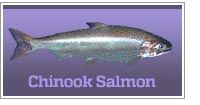
Chinook stop feeding once they acclimate fully to freshwater during the spawning process. Ideal water temperature: 42° to 50°
World record: 97 pounds, 4 ounces
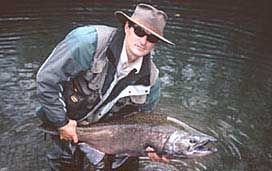
Identification: black mouth and black gum line. It is sexually dimorphic thus significantly distinct in it’s appearance of both sexes. The kype of the male distends with the upper and lower jaw morphing to create hooked or curved snouts. The dorsal area of the maturing chinook is dark black in the ocean and green to brown in rivers and streams; the large spots can be found from top to bottom of the tail fin. Chinook salmon can attain weights of 18 to 30 pounds but have been known to get over 100 pounds heavy.
Distribution: found throughout the eastern Pacific Ocean along the coastline of North America from southern California to the aleutian islands of Alaska; and then to the Bering Sea.
Lifespan: 4 to 8 years in the ocean before returning to freshwater natal streams to spawn.
Angler value: highly prized as the apex food fish quarry by anglers and commercial fishermen.
Techniques of fishing: Drift-Fishing, Fly Fishing, Plunking, Bobber-jig, Spinners, Spoons, Top water baits, Crank baits, and Side drifting are some of the many techniques that can be used but the most widely used on the opens sea is trolling during dawn and dusk.
Seasons to fish: May to early October with the saltwater season the first few months.
Chum Salmon a.k.a. Dog salmon & Blue-backs
oncorhynchus keta
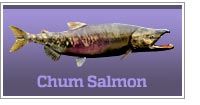
The chum salmon is a deep running fish that rarely jumps. Ideal water temperature: 50° to 60°
World record: 35 pounds, 0 ounces
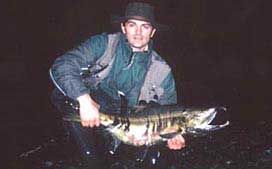
Identification: in the oceanic environment they are chrome, sleek. While chum are void of stripes and barbs in saltwater, the strips can be seen by tilting the landed fish one way or another; the barbs further distinguish it from other species of salmon. As they mature the green back, purple and gray barbs are found along the lateral areas, which differentiate them along with the kype of the male distended with large canine-like teeth. The average weight is from 6 to 15-pounds but some have been taken weighing as much as 30 pounds.
Distribution: largely found along the west coast of the Pacific Ocean from Washington State to the Bering Sea.
Lifespan: 3 to 7 years; migrating out to sea where they feed on plankton most of their lives.
Angler value: not highly prized among seasoned anglers. Chum form schools that are so large that beginners can practice fishing for salmon with various fishing techniques.
Techniques of fishing: Since they are plankton feeder’s small lures and flies work best when they run shallow. When they run deep spinners, spoons, and buzz-baits are just the lures for aggravating them enough to strike.
Seasons to fish: June to the end of December with the saltwater season the first few months.
Coho Salmon a.k.a. Silver, Hooknose & Blue-back
oncorhynchus kisutch
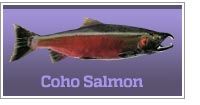
Coho salmon are notorious jumpers and spinners when they are hooked. Ideal water temperature: 48° to 58°
World record: 33 pounds, 4 ounces
Identification: white mouth and black gum line; spots along the dorsal area are found. When in the oceanic environment Coho salmon are so bright that the back is blue, which is why they are sometimes called blue-backs. Coho attain average weights of 12 to 18-pounds. In some coastal areas Coho can be found to average 20 to 24-pounds.
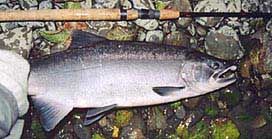
Distribution: found primarily in the eastern Pacific Ocean along northern California to the Aleutian Islands. Lifespan: 3 to 6 years; they migrate out to sea after the first year in freshwater, sometimes 2, where they feed on baitfish most of their lives. As they migrate back to natal streams where they cease to feed after holding in estuaries for a short period of time.
Lifespan: Coho live from 4 to 6 years old.
Angler value: highly prized for their size, color, and fight. They are a very valuable food fish to the commercial industry.
Techniques of fishing: many fish taken in saltwater are trolled but they can be taken on spinners, jigs, and flies. The more mature Coho become the easier it is to take them on spinners, spoons, and flies.
Seasons to fish: Mid May to mid November with the saltwater season the first few months.
Kokanee Salmon
Oncorhynchus nerka
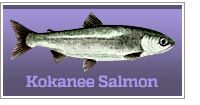
Kokanee are sockeye salmon which live their entire life in fresh water, not migrating to the ocean. Ideal water temperature: 48° to 58°
World record: 9 pounds, 10 ounces
Sockeye salmon which remain landlocked, never migrating to the ocean, are called kokanee salmon. Typically kokanee average one to two pounds. They are plankton feeders and very sensitive to water temperature. They school in lakes at depths which remain ideal temperatures. Once this depth is identified, schools can be found where they are easily caught. Use small lures trolled at the appropriate depth. The can also be caught using corn, but the main way they are caught is using flashy lures which they attack when the lure intrudes their space.
Pink Salmon a.k.a. Humpback or Humpy
oncorhynchus gorbuscha
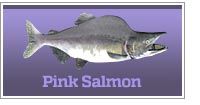
Pink salmon are excellent fighters on light line. Ideal water temperature: 45° to 55°
World record: 14 pounds, 8 ounces
Identification: white mouth, pointed head and mouth. During the spawning cycle males have a large hump on the back. The spots along the back, of both male and females, can be seen in open ocean waters. The average weight of the humpy ranges from 3 to 6 pounds.
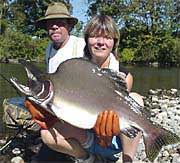
The recent world record is 14.49 pounds, caught by Avis Pearson. Pinks can be caught with light hook and line, but frustrate many fishermen due to the finicky tastes of these anadromous fish.
Distribution: they are found along the Eastern Pacific coast with a range from Northern California to Southern Alaska. During the last stages of migration the pink salmon will rarely travel more than a couple of miles inland. Anglers who want to fish for them will have to watch tides as well as significant rainfall that cause rivers to rise suddenly signaling pinks to swim upstream.
Lifespan: Pinks live between 3 and 5 years before heading inland to the estuaries and streams of their birth.
Angler value: Low, in that the ability to find them in the open ocean is often hard for the novice and difficult to entice once found.
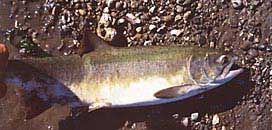
Techniques of fishing: small tackle should incorporate light spinner blades or flies. They prefer offerings with the colors pink and red near the bed of bays and rivers. As they migrate inland they will seek shallow areas of rivers and streams and can often be taken near banks even when rivers run turbid.
Seasons to fish: May to the end of September with the saltwater season the first few months. Note that Pink runs vary by the location and year but always run every two years. A run of pinks that runs the year 2005 will not reappear until 2007. A run of Pinks during 2006 will not reappear until 2008. The best resource for tracking pinks, every other year, is the regulation handbook.
Sockeye Salmon a.k.a. Red Salmon & Kokanee
oncorhynchus nerka
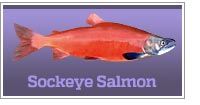
Called landlocked salmon, the most important salmon for commercial fishermen. Ideal water temperature: 54° to 64°
World record: 15 pounds, 4 ounces
Identification: chrome in open ocean turning colors with inland migration. The color of the body turns red with the head turning green. The distinctive orange eyes make it easily identifiable from other salmon. Males develop a large hump akin to the pink salmon. The average weight of the sockeye ranges from 5 to 6 pounds. Anglers can catch them on small gear but the techniques vary greatly by region and country; however, most are taken on flies and drift-fishing gear.
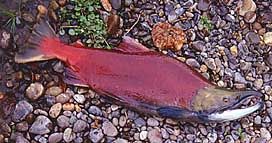
Distribution: they’re found along the west coast of North America with a range from Northern California to Southern Alaska. The lion’s share of sockeye can be found along the coast of Canada where they enter rivers by the millions making them one of the most sought after fish in North America.
Lifespan: Sockeye live to be 3 to 5 years old.
Angler value: Extremely high, in freshwater and almost non-existent in saltwater.
Techniques of fishing: small tackle of flies and spinners during the fall months. They can be found swimming near the surface of many rivers and estuaries, but that is not the same when in the open ocean where they travel deep and unseen. The preferred colors of lures and flies are orange and red and should be fished very slowly beneath the surface and with current speed on the surface.
Seasons to fish: April to the end of October with the saltwater season first few months.
Alaska Salmon Fishing Video - Red Salmon.
Watch as red salmon are fought and landed in Alaska.
Salmon Fishing on the Columbia River.
Watch as a nice red salmon is fought and landed on the Columbia River in the Pacific Northwest.
A A Fishing wishes to extend a debt of gratitude to Timothy Kusherets for contributing a wealth of knowledge about salmon and steelhead fishing.
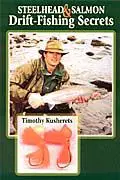
Timothy Kusherets offers great fishing information in his book - Steelhead & Salmon Drift-Fishing Secrets.
See listing of world records and Mr. Kusherets personal bests here.
Recommended Reading:
Steelhead & Salmon Drift-Fishing Secrets
by Timothy Kusherets
Sensory Processing in Aquatic Environments
by Shaun P. Colin and N. Justin Marshall
The Lore of Sportfishing (Spinning & Baitcasting)
by Jens Ploug Hansen and Goran Cederberg
Salmon Organizations
Atlantic Salmon Federation
Atlantic Salmon Trust
Atlantic Salmon Museum
Pacific Salmon Commission
Pacific Salmon Foundation
States offering salmon fishing.


Contribute Salmon Fishing Information
If you have information, articles or photos relating to salmon fishing which you would like to see published here, please submit them for consideration. We will gladly give you credit for your contribution. Salmon articles can be listed on the general fishing articles page, under the salmon articles category, or can be listed under fishing articles in a specific state.
Fishing Information